
The Industry Challenge: Construction Safety for Super High-Rise Buildings
Constructing super high-rise buildings—typically defined as those exceeding 150 meters in height—brings a unique set of engineering challenges. As these structures reach higher into the sky, they face increased risks from high winds and other weather factors. At the same time, moving materials up to great heights becomes far more complex.
In such demanding environments, traditional scaffolding systems, which require repeated dismantling and reinstallation on each floor, become not only inefficient but also hazardous. Falls from height remain one of the leading causes of deaths in construction worldwide, and this risk grows significantly once a building surpasses 150 meters. Additionally, when tower cranes have to switch between moving scaffolding and lifting critical items like rebar or concrete, this often creates a bottleneck, slowing down the entire project.
Weather adds another layer of difficulty. Wind speeds at altitudes above 150 meters are typically 30-50% higher than at ground level. According to the GTP100 product manual, climbing operations must only be carried out under suitable weather conditions—specifically, when there is no thunder, rain, snow, fog, frost, haze, or hail, and when the basic wind pressure does not exceed Level 5 (approximately 24.5-28.5 m/s). When wind speeds exceed Level 7 (approximately 13.9-17.1 m/s), the climbing formwork bracket requires typhoon reinforcement measures.
To tackle these challenges, automatic hydraulic climbing systems have emerged as a solution. The GTP100 Automatic Hydraulic Climbing Formwork and Protection Screen System, developed by GETO Group, is designed specifically to improve safety, speed up construction cycles, and reduce overall costs for super high-rise residential, mixed-use, and infrastructure projects.
The Core of the GTP100 System: Hydraulic Power and a Fully Steel-Hardened Structure
At the heart of the GTP100 system is a powerful hydraulic drive mechanism. Unlike manual methods that rely on cranes or hand-operated winches, the GTP100 uses a self-contained hydraulic jacking system. This provides substantial lifting force, capable of raising not only its own weight but also the integrated formwork, working platforms, and any construction materials stored on them.
Hydraulic Power Specifications
The GTP100 hydraulic system delivers up to 100 kN of lifting force per climbing unit—enough to lift a fully loaded platform weighing several tons. This power comes from double-acting hydraulic cylinders connected to a central power pack. This power pack distributes pressurized oil to all climbing units at the same time, ensuring synchronized movement across the entire building perimeter.
A Fully Steel-Hardened Structure for Fire Resistance and Stability
The GTP100 system is built with a fully steel-hardened structural design. All critical parts—including the climbing rails, hydraulic cylinders, anchor bolts, and platform frames—are made from high-strength steel alloys chosen specifically for their performance in super high-rise environments.
- Fire Resistance: Steel does not burn. In the rare event of a construction site fire, the GTP100 system maintains its load-bearing capacity, providing a safer environment for evacuation and emergency response.
- Structural Stability at Height: Steel's high modulus of elasticity minimizes deflection under heavy wind loads. Even at altitudes exceeding 200 meters, the GTP100 platforms remain stable and secure.
- Durability and Corrosion Protection: The steel components are treated with advanced anti-corrosion coatings, such as hot-dip galvanizing and specialized anti-rust paints, to withstand long-term exposure to rain, humidity, concrete splash, and chemicals. This protection system is designed for a service life of over 10 years with minimal maintenance.
The Climbing Principle: Alternating Ascent Driven by Hydraulic Cylinders
Understanding how the GTP100 climbs requires a clear explanation of its alternating ascent logic. This design is inspired by how a bipedal creature moves: one leg stays fixed while the other advances, ensuring continuous stability and safety throughout the motion. This approach eliminates any moment where the system is left hanging or unstable during the climb.
The Three Core Components
The GTP100 system operates through the coordinated interaction of three main structural elements:
- The Hydraulic Cylinders: The power source. Each climbing unit has heavy-duty hydraulic cylinders that extend and retract to create vertical movement. They are double-acting, meaning they can push and pull with equal force, allowing both upward and downward control.
- The Climbing Rails: Vertical steel tracks anchored to the already-completed floor slabs using high-strength anchor bolts embedded in the concrete. The rails act as the fixed guide path for the climbing unit to ascend.
- The Climbing Brackets / Shoes: The interface components that engage with the climbing rails. They contain mechanical locking mechanisms that alternately grip the rail to hold the system in place while the other brackets advance.
The Step-by-Step Alternating Ascent Process
The climbing sequence is operated through centralized hydraulic control with a simple lever operation:
- Load Transfer to Upper Anchors: The cycle begins with all mechanical shoes engaged and the system securely anchored. The hydraulic cylinders extend slightly, transferring the entire weight of the climbing unit from the lower anchor points to the upper anchor points on the rail.
- Lower Shoe Release and Rail Advancement: The lower mechanical shoes disengage, releasing the lower portion of the climbing rail from its anchors. The hydraulic cylinders then retract, pulling the rail upward to the next level of pre-installed anchor bolts.
- Lower Anchor Re-engagement: Once the climbing rail reaches its new height, the lower anchor shoes automatically re-engage, locking the rail securely into position. The hydraulic cylinders then fully retract, drawing the climbing unit snug against the rail. The system is now ready for the next cycle or for concrete pouring.
This alternating sequence ensures the climbing unit is always securely anchored to the building. There is no moment of free-hanging or instability during the ascent.
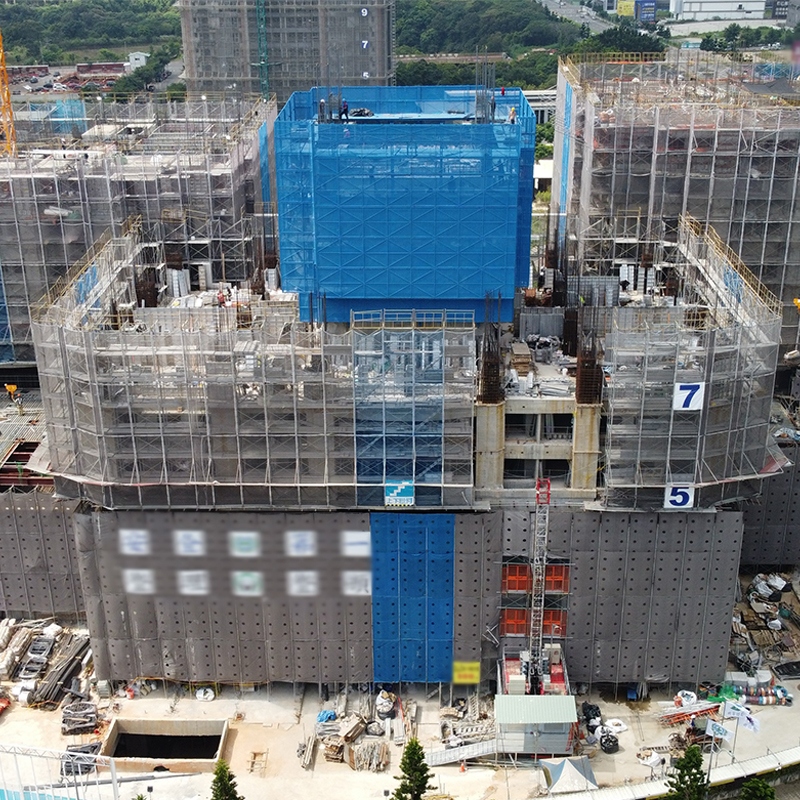
Vertical Segment Differentiation: Customizing for Residential vs. Public Building Facades
A one-size-fits-all approach doesn't work for climbing protection screens. The facade geometry, platform needs, and safety requirements differ greatly between high-rise residential towers and large-span public buildings like stadiums or convention centers. GETO has addressed this by developing scenario-specific customization strategies for the GTP100 system.
High-Rise Residential Facades
Residential towers often have complex facade geometries, including balconies, bay windows, and air conditioning ledges. For these applications, the GTP100 system is configured with:
- Multiple Working Platforms: Residential projects often require three or four levels of working platforms operating at the same time to support a fast-paced construction cycle (e.g., one level for formwork installation, another for rebar tying, another for concrete pouring).
- Flipping Platform: The system incorporates a flipping platform mechanism that can be temporarily displaced outward by 300-500mm. As documented in the product manual, this flipping platform enables direct lifting of formwork for replacement when needed, and also allows the system to accommodate protruding balcony slabs or other obstacles during climbing. After passing the obstacle, the platform flips back to its standard position.
Public Building Facades
Public buildings like stadiums, museums, and office towers often have highly irregular geometries—large-span, column-free interiors, and smooth continuous facades with few projections. For such complex, free-form structures, the GTP100 system is not ideally suited. Climbing formwork works best for repetitive, vertical core structures, not for curved or parametrically designed buildings.For these applications, the GTP100 system is optimized differently:
- Fewer but Larger Platforms: Public building facade construction typically needs fewer levels of working access—often only two or three platforms. However, each platform needs to be wider and more open to handle heavy materials like large glass panels, stone cladding units, and prefabricated facade elements.
- Simplified Anchor Layouts: Because public buildings often have taller floor-to-floor heights and different structural systems, the anchor spacing and climbing rail configurations are adjusted to match the specific structural grid.
Adapting to Extreme Conditions: ±10° Inclined Climbing and Multi-Functional Platforms
One of the most technically impressive capabilities of the GTP100 system is its ability to climb at an inclined angle of up to ±10 degrees (as specified in the product manual's technical data table). This feature is essential for constructing structures that are not purely vertical.
The Engineering Challenge of Inclined Structures
Many high-profile infrastructure and architectural projects require building inclined or tapered elements. Examples include bridge pylons, communication towers, hydroelectric dams, silo structures, and iconic tapered towers. Standard vertical climbing systems cannot handle these geometries.
The Adjustable Spindle Rod Solution
GETO engineers solved this challenge by incorporating adjustable spindle rod mechanisms into the GTP100 climbing brackets. These adjustable connections, which function like threaded jackscrews, allow the climbing rails and platforms to be precisely angled to match the building's geometry.
- Capabilities: The system can handle both inward (negative) inclination for structures that taper inward, and outward (positive) inclination for flared geometries, up to ±10 degrees from vertical.
- Incremental Adjustment: This ±10-degree range is not a fixed setting; it can be adjusted floor by floor as the building's geometry changes. For a tower that tapers continuously, the engineering team recalculates the anchor positions and spindle rod lengths for each climbing cycle.
Multi-Functional Platform Integration
Beyond climbing and protection, the GTP100 platforms also serve as multi-functional work zones.
- Concrete Distribution Booms: Pump lines can be routed through dedicated pathways on the platforms to reach the pouring face, helping maintain a continuous pour.
- Precast Component Storage: Cladding panels, window units, and other prefabricated elements can be staged on the upper platforms, ready for immediate installation after the climbing operation.
- Temporary Lighting and Power: Electrical outlets, lighting fixtures, and small tool storage cabinets can be integrated into the platform design.
- Material Hoisting: Small electric hoists or davit cranes can be mounted on the top platforms to lift lightweight materials from floor to floor, further reducing demand on the tower crane.
Safety Features of the Fully Enclosed Protection System
For any climbing system used at heights exceeding 150 meters, safety is not an add-on—it is the core design principle. The GTP100 system incorporates multiple layers of mechanical safety technology, as documented in the product manual.
Mechanical Locking and Fall Protection Features
Mechanical Locking Shoes: The system uses dual mechanical shoes that engage with the climbing rail at all times. These shoes are spring-loaded to default to the locked position; hydraulic pressure is required to disengage them. This is a fail-safe design.
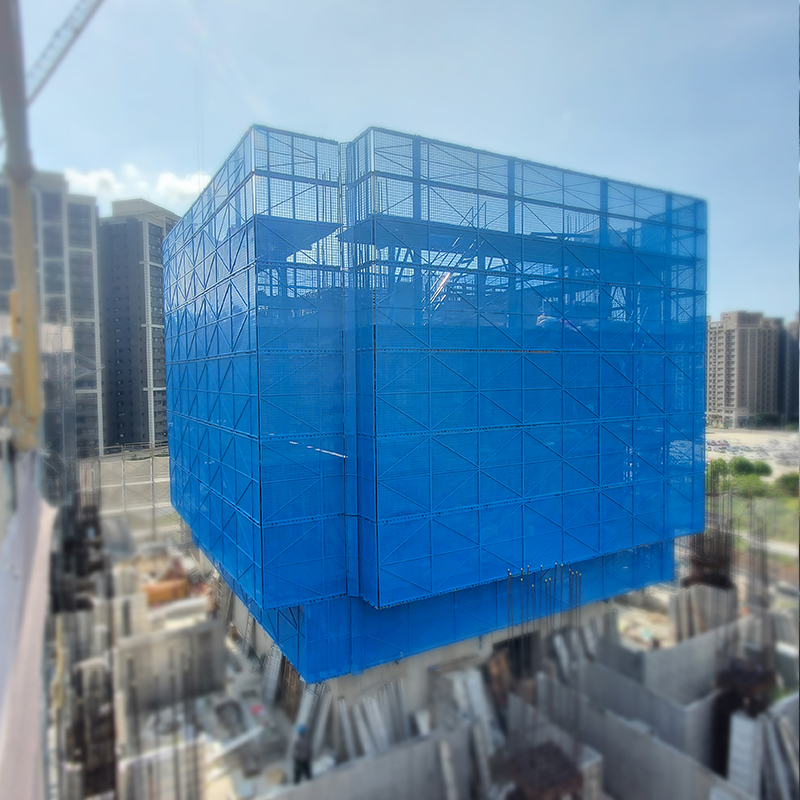
- Fully Enclosed Steel Protection Screening: As stated in the product manual, the climbing bracket utilizes fully enclosed steel protection screening, which prevents falls and provides wind protection.
- Full-Height Enclosed Platforms with Steel Decking: All working levels feature solid steel decking with non-slip surfaces, surrounded by guardrails and toe boards to prevent tools or debris from falling.
- Toe Boards: The manual specifies that toe boards are required on each platform.
- Safety Net Integration: For additional fall protection and debris containment, safety nets can be suspended between the lowest platform and the next lower floor.
- Lightning Protection: The system incorporates a dedicated lightning protection pathway that bonds all steel components to the building's main lightning protection system
The "1+N" Integration Advantage: Synergy with Aluminum, Steel, and Timber Beam Formwork
The GTP100 climbing system does not operate in isolation. It is a key component of GETO's broader "1+N" Integrated Construction Solution.
Seamless Integration with Aluminum Formwork
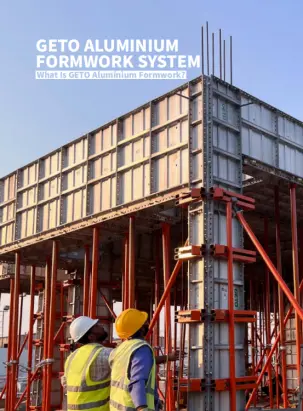
For high-rise residential projects—the most common application for the GTP100 system—the climbing protection screens work in synergy with GETO's aluminum formwork system. According to the product manual, the GTP100 is compatible with aluminium formwork, steel formwork, and timber-beam formwork.
- Shared Anchor Points: Where structurally feasible, the climbing rails for the GTP100 system are anchored using the same bolt holes or embedments that are later used for the aluminum formwork.
- Compatible Working Heights: The platform levels of the GTP100 system are positioned to align with standard aluminum formwork panel heights, giving workers ergonomic access.
Compatibility with Steel Formwork and Timber-Beam Formwork
For infrastructure applications like bridge pylons, where steel formwork is often preferred for its high load capacity and abrasion resistance, the GTP100 system is equally compatible. The heavy-duty nature of steel formwork is well-matched to the 100 kN lifting capacity of the GTP100 system. The system is also fully compatible with timber-beam formwork, offering flexibility for projects where timber formwork is preferred based on local practices.
The Fully Enclosed Construction Environment
When the GTP100 protection screens are combined with GETO's wall and slab formwork, the entire construction front becomes a fully enclosed, weather-protected environment. This delivers several competitive advantages:
- Reduced Weather-Related Downtime: The enclosure protects both workers and fresh concrete, allowing construction to continue during light rain or moderate winds (within the system's design limits for safe operation as specified in the manual).
- Zero Debris Fall: The continuous enclosure—with solid decks, toe boards, perimeter screens, and safety nets—prevents tools, materials, or concrete fragments from falling off the building.
- Reduced Labor Costs: Because the GTP100 system climbs automatically with simple centralized hydraulic control, fewer workers are needed for site safety inspections and material movement.
International Project References
The technical specifications and safety features of the GTP100 system are validated by its successful deployment on projects around the world.
Residential Building Project, East Asia
A high-rise residential building project in East Asia utilized the GTP100 Automatic Hydraulic Climbing Formwork system. The project involved a residential tower requiring efficient floor cycles and a fully enclosed construction environment for worker safety.
GETO supplied a customized GTP100 system with multiple working platforms and fully enclosed steel protection screening.
Results: The GTP100 system successfully climbed the entire tower height. The system enabled efficient floor cycles, and the fully enclosed steel protection screening effectively contained debris and provided a safe working environment.
Office Building Project, East Asia
An office building project in East Asia also deployed the GTP100 system. The project benefited from the system's hydraulic climbing capability and compatibility with the project's formwork solution.
Additional Global References
- Projects in Oceania: In high-rise residential towers where wind loading is a significant challenge, GTP100 systems were specified specifically for the enhanced stability provided by the steel-hardened design.
- Projects in the Middle East: In major Gulf cities where extreme summer heat and dust storms pose unique challenges, GTP100 systems were deployed with appropriate hydraulic system configurations to ensure reliable operation. The fully enclosed protection screens provided essential shade and dust protection for workers.
- Projects in Southeast Asia: On bridge pylon projects, the ±10-degree inclined climbing capability of the GTP100 system was essential for forming the tapered tower geometries. The adjustable spindle rods were recalculated and reset for each climbing cycle as the pylon taper angle changed.
These projects collectively prove that the GTP100 system is a field-validated technology capable of meeting the rigorous demands of international contractors across diverse geographic and climatic conditions.
Conclusion: A Technology Partner for the Vertical Urban Age
The GTP100 Automatic Hydraulic Climbing Formwork and Protection Screen System from GETO Group addresses the core challenges of this vertical urban age, as documented in the product manual:
- Safety: Through fully enclosed steel protection screening, mechanical fail-safe locking shoes, steel decking with toe boards on all platforms, and a design that prioritizes worker security at height.
- Efficiency: Through 100 kN hydraulic lifting capacity, an alternating ascent design that eliminates dismantling and reassembly, centralized hydraulic control with simple lever operation, and seamless integration with aluminum, steel, and timber-beam formwork systems.
- Adaptability: Through ±10-degree inclined climbing capability for tapered towers and bridge pylons, adjustable spindle rod mechanisms, and facade-specific customization for residential (multi-platform) versus public building (large-platform) applications.
- Global Validation: Through successful deployment on residential and office building projects in East Asia, as well as infrastructure projects across Oceania, the Middle East, and Southeast Asia.
For developers, contractors, and engineering firms planning their next super high-rise residential tower, mixed-use development, bridge pylon, or specialized infrastructure project, GETO's GTP100 system provides the technical foundation for safer, faster, and more sustainable vertical construction.
Partner with GETO to bring your most ambitious tower designs to life, with hydraulic climbing technology that rises to the challenge floor after floor—safely, efficiently, and reliably.