
On a modern high-rise or a long-span bridge, ringlock is what you see almost everywhere now. On a low-rise brick job, frame scaffolding is still doing the same work it has always done. Cuplock sits somewhere between the two. All three are steel tube, but the join between one tube and the next decides almost everything that follows: how fast the job goes up, how much weight it carries, and what tends to go wrong.
The decision feels harder than it should because every supplier claims the same things. Speed, strength, safety. Strip those claims away and the three systems are actually easy to tell apart, because each one succeeds and fails in its own way. The sections below go through them one at a time, then look at what they cost and what breaks.
The connection is the whole system
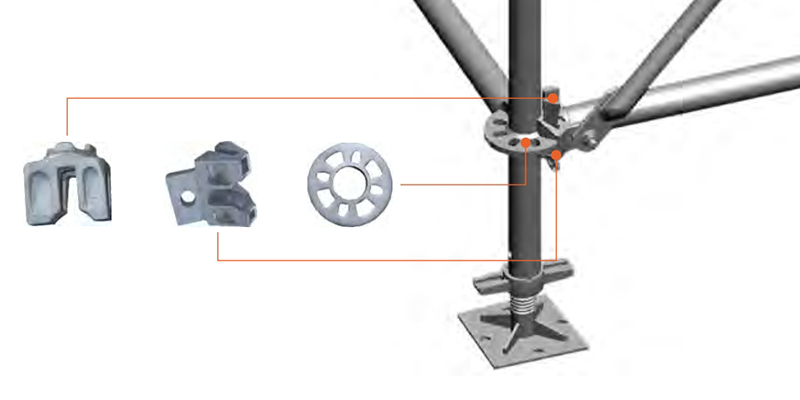
A ringlock standard carries a rosette ring welded to the tube, and the ledger ends in a wedge that drops into the ring and locks with one hammer blow. There is little to fit and little to forget. The ring accepts ledgers at several angles, so the same pieces turn corners and follow curves without needing a second product line. For a crew, this means almost no thinking at the joint: the wedge either seats or it does not, and a seated wedge stays put until someone knocks it out again.
Cuplock works with a fixed bottom cup and a sliding top cup. The blade on the ledger sits in the bottom cup, and the top cup is spun down to close it. The result is a stiff, dependable node, which is why heavy civil work relied on it for years. The weak point is the cup and blade themselves. Every time the gear is loaded, dropped or dragged, those edges take abuse, and a deformed cup or blade is where failure begins. Cuplock also works at fixed vertical spacing, so a floor height that does not divide neatly into the modules leaves the crew improvising.
Frame scaffolding is just welded H-frames stacked and braced. Almost anyone can put it together, which is its strength on simple jobs and its ceiling everywhere else. There is no real node to speak of, which keeps it cheap, and it was never meant to carry the loads people sometimes ask of it.
Where each one earns its keep
Frame belongs on straight, low-rise, light work. Brickwork, rendering, plastering, a repaint of an existing facade. It is the cheapest way to put a platform against a wall, and there is no point paying for more system than that job needs. The moment the shape stops being a simple box, frame starts needing couplers, boards and improvisation, and the savings quietly disappear.
Cuplock still makes sense where a site already owns a good cuplock fleet and the crew knows it. If the cups are clean, the stock is sound and the loads are genuinely heavy, there is no reason to throw a working system away. The case for moving on appears when the geometry gets irregular, when the vertical spacing no longer fits the structure, or when the fleet is ageing and every second cup needs rejecting before it reaches the job.
Ringlock is what most contractors now reach for when the loads are high, the shape is awkward, or one system has to do access and support on the same project. It goes up quickly, carries more for its weight, and handles awkward shapes. It also travels well between jobs, because the same components serve as access towers, support towers and falsework. A contractor who standardises on ringlock stops keeping three fleets and three sets of spares, and the crew stops learning three different systems.
The numbers people actually compare
Nobody argues about whether ringlock is strong. The argument is about money. Ringlock costs more per tonne, and that is where most discussions stop, which is a mistake. The figure that matters is cost per use, and it is built from a handful of things: how fast the scaffold goes up, how many cycles the steel survives, and how much of the fleet can be reused on the next job.
|
|
Ringlock |
Cuplock |
Frame |
|
Load capacity |
Highest for its weight |
High, proven |
Lower |
|
Erection speed |
Fastest |
Moderate |
Fast on simple jobs |
|
Adaptability |
Corners, curves, multiple uses |
Fixed geometry |
Repetitive boxes only |
|
Loose parts |
Few |
More to inspect |
Few |
|
First cost |
Higher |
Moderate |
Lowest |
Frame looks cheap until it is asked to carry structure it was never rated for. Cuplock's cost depends on the condition of the fleet; a clean, well-run cuplock yard can keep earning for years, while a battered one becomes a rejection and inspection problem. Ringlock usually comes out ahead on the full-life number because it erects faster, survives more cycles, and one fleet covers access and support instead of two.
The same logic applies to rental against purchase. If a system will be used across many projects, owning it and managing it as an asset usually wins. For a single short job, rental avoids the cost of storing and maintaining idle steel. Either way, the useful question is not what the per-tonne price is, but what one use of one bay costs.
What goes wrong over time
Frame fails when it is overloaded or built too high without proper ties. The steel is rarely the problem; the way it gets asked to do more than its design is.
Cuplock fails when a damaged cup or blade slips through inspection. That is why a cuplock yard lives or dies by its inspection discipline. A quick visual check at the gate is not enough; cups and blades need looking at before every reissue.
Ringlock's weak point is mixed or substandard components from unknown sources. A wedge from one maker and a rosette from another can look identical and still not fit, and a bay that fits today can be loose tomorrow. Buy from a source that controls the whole system and can trace the steel, rather than topping up a fleet with whatever is cheap.
Hot-dip galvanizing matters for all three, and most of all in humid or coastal air, because corrosion attacks the connection before it attacks the tube. A scaffold that looks fine from ten metres away can be corroding at the exact points that carry its strength.
The paperwork still matters
None of this removes the need for design. A scaffold is a temporary structure, and the load it is asked to carry has to be calculated against the height, the bracing, the ground and the tie pattern. The differences between systems are real, but they do not buy anyone out of that calculation. A light frame access scaffold and a ringlock falsework tower are simply not in the same load class, even when the tubes are the same diameter.
The practical test is what arrives with the gear. For support and falsework work, the supplier should hand over a calculation and an inspection plan, not just a delivery note. When a supplier cannot or will not produce those documents, the low price is usually hiding the missing engineering, and that is the one cost that cannot be cut.
The short version
If the work is light, low-rise and repetitive, use frame. If you already run a sound cuplock fleet on heavy civil work, keep using it. For everything demanding, awkward or multi-use, ringlock fits the job best.
We make ringlock scaffolding, steel props and formwork systems, and we do the design calculations with them. If you want a straight cost-per-use comparison for your project, send us the loads, heights and programme through our contact page and we will work one up.