
There is no single "best" scaffolding system. There is only the system that best fits the job in front of you. The right choice depends on three things: what the scaffold has to do (give workers access, or carry the weight of a structure), how high and how heavily loaded it will be, and how many times you plan to use it. Get those three right and scaffolding becomes a controlled cost rather than a source of delay and risk. Get them wrong and you pay twice, once in the initial purchase or rental and again in slower erection, rework and safety exposure.
This guide explains the main scaffolding systems, how they compare, and how to choose the one that matches your project, your site conditions and your budget. It closes with a seven-step selection checklist you can apply to any job.
What a scaffolding system actually means
Scaffolding is often treated as a single product, but the word covers three distinct jobs on a construction site.
Access scaffolding gives workers a safe, stable platform to reach the work face, whether that is a building facade, an interior wall or a piece of plant. The load is mostly people, tools and light materials.
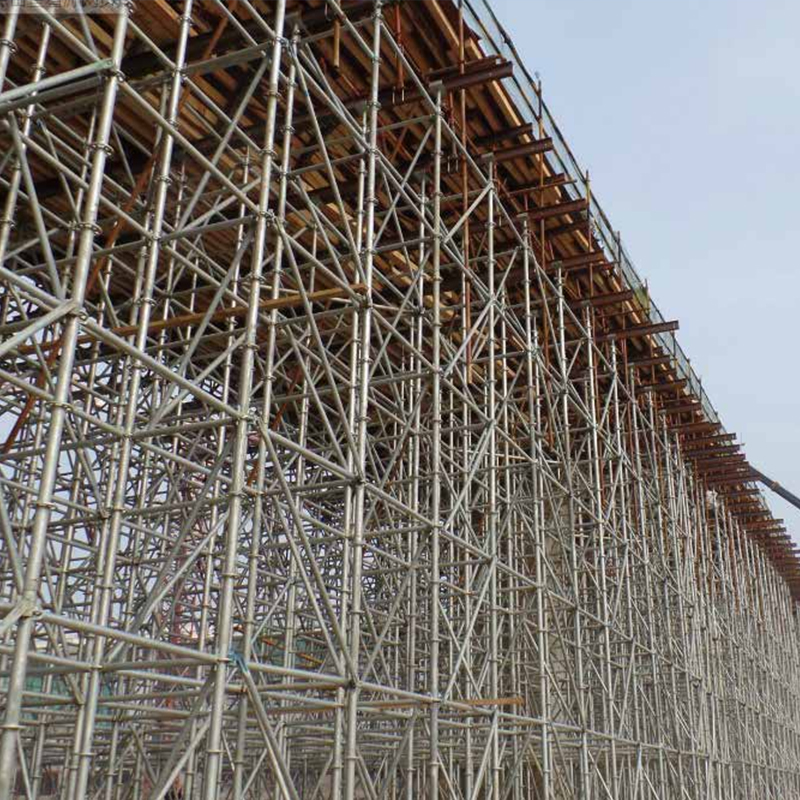
Support scaffolding (falsework) temporarily carries the weight of a structure until it can support itself. Slab soffits, beams, bridge decks and column forms all rely on support scaffolding to hold fresh concrete and formwork. Here the load is structural and often much higher.
Shoring is a specialist form of temporary support used to brace walls, excavations or damaged structures, or to transfer load during propping and stripping.
Most "systems" on the market can do more than one of these jobs, but they are optimised for different ones. A frame system is quick and cheap for light facade access. A ringlock system is engineered for heavy falsework and long-span support. Understanding that distinction is the first step to choosing correctly.
Every system is built from a small set of standard parts: standards (the vertical members), ledgers (the horizontal members), transoms, diagonal braces, adjustable base jacks, and connectors that join them. The real difference between systems is not the tube, but the node, the connection point where standards and ledgers meet. The node determines how much load the assembly can carry, how fast it can be erected and how much depends on skilled labour and correct installation.
The main scaffolding systems compared
Five systems cover most construction work. They differ in connection design, load capacity, erection speed and cost.
|
Dimension |
Cuplock |
Frame |
Tube-and-coupler |
||
|
Connection |
Wedge head locks into a rosette ring on the standard |
Blade on the ledger sits in a cup welded to the standard |
Welded H-frames stacked and braced |
Steel tube joined by right-angle, swivel and sleeve couplers |
Telescopic tube with pin or threaded adjustment |
|
Strengths |
High load capacity, very fast erection, few loose parts, one system for access and support |
Strong and stable node, proven on large civil jobs |
Cheap, light, fast for low-rise repetitive work |
Maximum adaptability to any shape |
Simple, fast, cheap for slab soffit support |
|
Limitations |
Higher first cost; needs compatible, quality-checked components |
Less flexible than ringlock; cup and blade can be damaged and must be kept clean |
Lower load capacity, limited adaptability to complex shapes |
Slow, labour-intensive, quality depends heavily on coupler torque |
Point support only, no working platform |
|
Best for |
Heavy falsework, long spans, high-rise, complex geometry |
Large slabs, heavy civil and industrial structures |
Masonry, rendering, low-rise facade access |
Heritage work, awkward geometry, temporary bespoke structures |
Slab formwork, beam soffits, reshoring |
Ringlock scaffolding is the fastest-growing category and the default choice for many contractors today. Its rosette connection is self-aligning and locks with a wedge and a single hammer blow, so it tolerates less-skilled crews and erects significantly faster than tube-and-coupler work. Because the same ring can accept ledgers at multiple angles, one system handles straight runs, curves and corners without switching product families. It is also the strongest of the common systems on a per-kilo basis, which is why it dominates bridge, tunnel, high-rise and long-span applications. A further advantage is that the same components can be configured as access towers, support towers or falsework, so a contractor can carry one system across several applications instead of three. For rental companies, the small number of loose parts and standard modules simplify counting, inspection and reuse, which keeps the fleet productive and the residual value high.
Cuplock remains strong in heavy civil work where its cup-and-blade node has decades of proven performance. The blade on each ledger drops into a cup welded to the standard, and the top cup is tightened to lock the assembly, giving a stiff, repeatable node. It is a good, safe system, but it is less adaptable than ringlock, and its cup welds and blade ends must be inspected carefully after rough handling, because a deformed cup or blade is exactly where a failure begins. Because cuplock is typically set at fixed vertical increments, it is also less convenient when floor-to-floor heights do not divide neatly into standard modules.
Frame scaffolding is the economical choice for repetitive, low-rise work such as brickwork, plastering and facade renovation. It goes up quickly and cheaply, and its welded H-frames need little skill to assemble, which keeps labour costs down. Its capacity and geometry are limited, however, and it is not designed for heavy structural loads. On anything taller or more irregular than a simple box, frame systems quickly run out of adaptability, and contractors end up mixing in couplers and boards to make things fit, which erodes the savings.
Tube-and-coupler is rarely the first choice for new work because it is slow and labour-intensive. It earns its keep on heritage buildings, irregular facades and one-off structures where no standard system fits. Its safety depends almost entirely on correct coupler tightening and experienced erection crews, so inspection must verify torque rather than just visual completeness. On projects where no module system can follow the profile, tube-and-coupler is still the only practical answer, and the labour premium is simply the cost of doing that kind of work properly.
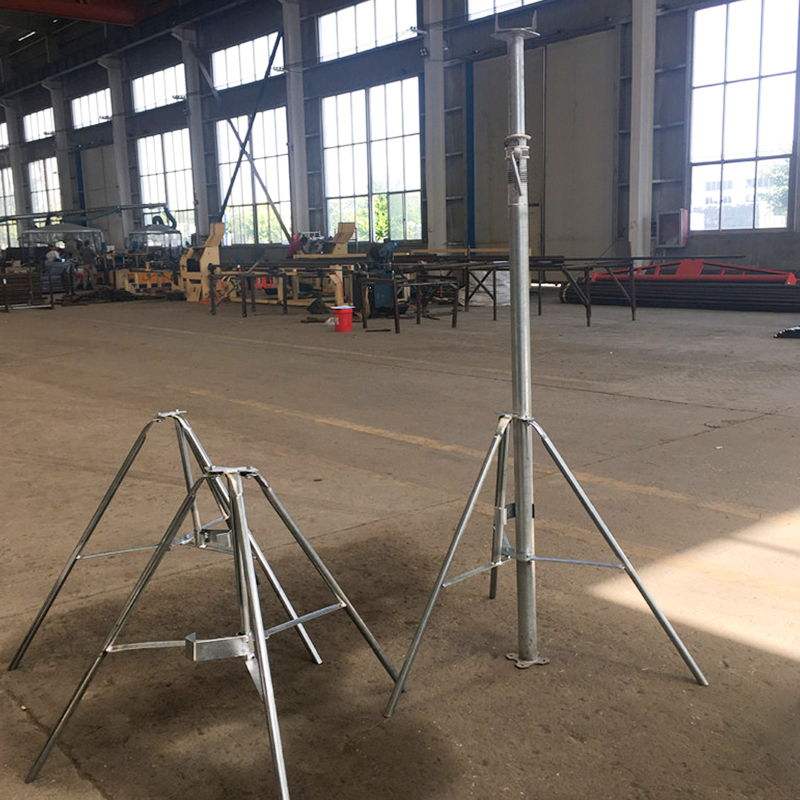
Steel props are not a platform at all; they are point supports. They are the fastest and cheapest way to support slab and beam soffits in combination with a formwork system, and they remain essential even on sites that use ringlock for the main structure. Pin-adjustable props suit rapid, repetitive reshoring, while threaded props give finer height control where the soffit level must be set precisely. Props look simple, but they still need a design that accounts for their load, their spacing and the re-shoring sequence, because a slab propped too early or stripped too soon fails independently of how good the formwork is.
Match the system to the application
The same five systems can be ranked differently depending on what you are building.
Residential and repetitive standard floors. Frame scaffolding for facade access combined with steel props, or a ringlock support tower, for slab soffits is the classic low-cost combination. Where the facade repeats floor after floor, an attached self-climbing scaffold can replace repeated frame erection entirely and remove the crane from the cycle.
High-rise and super-tall buildings. The key decision is whether the facade access system climbs with the building. Attached, self-climbing scaffolds reduce the number of times a crew builds and dismantles at height, which is both faster and safer. For the core and the slabs, ringlock support towers and a formwork system that strikes early shorten the cycle time of every floor. The scaffolding choice here is inseparable from the formwork choice.
Bridges, tunnels and long-span structures. These are falsework jobs first and access jobs second. The scaffold has to carry the dead weight of wet concrete and formwork over gaps, water or traffic. Ringlock and cuplock systems with engineered base jacks, diagonal bracing and heavy-duty standards are the norm, often supplemented by steel props and beams. Design calculations, load class and deflection control matter more here than anywhere else.
Industrial buildings, warehouses and temporary structures. High headroom and long clear spans favour ringlock support towers with props and beams. For plant maintenance and event structures, the same ringlock components can usually be reconfigured into access towers, which means one rented system serves several purposes on the same site.
Heritage, retrofit and awkward geometry. This is where tube-and-coupler still earns a living. When no standard bay size fits, a tube-and-coupler scaffold can follow any profile. It costs more in labour, but it is often the only system that fits the building without modification.
Cost and safety: the two numbers that decide
Two mistakes repeat across the industry. The first is comparing purchase price instead of cost per use. The second is treating scaffolding as a commodity instead of an engineered temporary structure.
Compare the total cost, not just the headline price. A ringlock system costs more per tonne than a frame system, but it carries more load, erects faster and survives more cycles, so the stronger system is often the better value over the life of the job. The same logic applies to aluminium versus steel: a lighter system may cost more upfront and pay back in faster handling and lower crane time. Ask for a clear unit price based on the quantities you need, so you can compare like for like.
Look for hot-dip galvanizing. Scaffolding lives outdoors and gets knocked around. Hot-dip galvanizing protects the tube and, just as importantly, the connection components, where corrosion causes dimensional problems and weakens the node. In humid, coastal or tropical conditions the difference between galvanized and lightly coated components is the difference between many safe reuses and early scrapping.
Confirm load class and design.Scaffolds are designed and tested to recognised international or local standards, or the equivalent local code. The relevant service load class must match the intended use: a light access platform must not be used as heavy falsework, and a heavy falsework design must be accompanied by calculations, a method statement and an inspection regime. The cheapest quote that skips the calculation is not a saving; it is an unmanaged risk.
Never overlook the ground and the ties. The best system fails the same way the worst one does if the base is soft or the structure is not tied back. Check ground bearing, use base jacks and sole plates, and follow the required tie pattern for the height and exposure. Instability is the dominant cause of scaffold collapse, and it is almost always a design, base or tie problem rather than a material problem.
Load classes, standards and documentation
A scaffold is an engineered temporary structure, and it should be treated like one. Before you commit to a system, confirm three things: the load class it is designed for, the standard it is designed to, and the documentation that comes with it.
Prefabricated scaffolding systems are designed and tested to recognised international standards or the equivalent national code. These standards define service load classes, which is the formal way of saying how much load each bay is allowed to carry. A light access scaffold and a heavy falsework tower are simply not in the same class, and using a lower-class system for a higher-class job is a serious error even if the tubes look identical.
For support and falsework work, the supplier should provide a design calculation, a method statement and an inspection plan, not just a delivery note. The calculation translates the loads, height, spacing, bracing and ground conditions into a specific layout, and the inspection plan tells the site team what to check before and after each pour or lift. When a supplier cannot or will not produce these documents, the price is almost certainly hiding the absence of engineering, which is the one cost you cannot afford to cut.
Documentation matters for the components too. Good fleets are traceable: the tubes, rosettes, cups and wedges come from a controlled production line with known material grades, and they are inspected between uses. Mixing components from unknown origins into a system is a common source of hidden weakness, because parts that look compatible may not have been designed or tested together.
Common selection mistakes to avoid
Most poor scaffolding decisions come from the same few errors, and they are all avoidable.
The first is choosing on purchase price alone. A cheap system that erects slowly and cannot be reused on the next job is more expensive than a stronger system that lasts across many projects. Compare like-for-like unit prices for the quantities you actually need, not just the lowest headline number.
The second is ignoring the difference between access and support. Scaffolding bought for facade access is pressed into service as falsework, without a calculation, when the programme changes. The result is overloaded standards and a collapse risk that nobody signed off.
The third is buying the system and skimping on the accessories. Base jacks, sole plates, diagonal braces, ladders, guardrails and ties are not optional extras. A system missing its bracing or ties is not a cheaper system; it is an incomplete one.
The fourth is failing to check the condition of used or rented stock. Bent standards, dented tubes, seized wedges and corroded nodes all reduce capacity. Inspect on arrival, quarantine damaged parts, and never accept a mixed batch from an unknown source.
The fifth is treating erection as unskilled work. Even a fast, self-aligning system needs trained crews who follow the tie pattern, the bracing layout and the inspection schedule. The system makes good erection faster; it does not make careless erection safe.
A seven-step selection checklist
Run through these seven steps before you order or rent, and the choice usually makes itself.
- Define the job. Is the scaffold for access, for structural support, or for shoring? This determines the load class and the whole product family.
- Estimate the loads. Add up people, materials, formwork and wet concrete. Include wind and dynamic effects for tall or exposed scaffolds.
- Fix the height, span and geometry. Straight, repetitive and low favours cheap systems. Tall, long-span or irregular favours ringlock and engineered designs.
- Choose the system. Pick the connection family that matches the load and geometry, and confirm it is available in the required size and finish.
- Check the material. Verify tube diameter, wall thickness, the condition of the nodes and the galvanizing. Reject mixed or damaged components from unknown sources.
- Assess the supplier. Confirm certifications, design and calculation capability, delivery reliability and local support before comparing price.
- Pilot the system. Erect a sample bay or tower, time it, and inspect it before committing the whole site to one system.
Frequently asked questions
What is the difference between ringlock, cuplock and frame scaffolding?
They differ mainly at the connection. Ringlock uses a wedge-and-rosette node that is fast to erect, strong and adaptable to many angles. Cuplock uses a cup-and-blade node that is strong and proven on heavy civil work but less flexible. Frame scaffolding uses welded H-frames and is cheap and quick for light, repetitive facade work but has lower capacity. See the comparison in our scaffolding systems overview.
Is ringlock scaffolding stronger than cuplock?
Ringlock systems are generally rated for high load capacity on a per-kilo basis and erect faster, but cuplock remains a legitimate heavy-duty option where it is already in use. The decisive factor is not the brand but the design calculation, the condition of the components and correct erection. Browse our ringlock scaffolding range for load data and configurations.
Should I rent or buy scaffolding?
If the system will be used across many projects, buying and managing it as a reusable asset usually wins. For one-off or short jobs, rental avoids storage, maintenance and the cost of idle stock. A good supplier will model both options against your project pipeline, which you can request through our contact page.
Do I need a self-climbing scaffold for a high-rise?
Not automatically, but for tall, repetitive facades a self-climbing system removes repeated build-and-strike cycles at height, cuts crane demand and improves safety. The breakeven depends on height, facade repetition and programme. See our self-climbing platforms.
Why does hot-dip galvanizing matter?
It protects the tubes and the connection components from corrosion, which preserves load capacity and makes components fit together cleanly over many reuses. It matters most in humid and coastal climates.
How do I evaluate a scaffolding supplier?
Check certifications, material quality and wall thickness, design and calculation capability, delivery reliability, and local engineering support. Then compare total cost of use, including transport, maintenance and residual value, not just unit price. See why contractors choose us on our GETO advantages page.
Can one scaffolding system be used for both access and support?
Yes, and that is one of the main reasons ringlock has become so popular. The same standard modules can be configured as an access tower, a support tower or falsework. The key is that each configuration still needs its own design and load check; the versatility of the system does not remove the need for engineering.
What should I inspect before using a scaffold?
Check the ground bearing and base jacks, the condition and alignment of the standards, the presence and tightness of all connections, the bracing and tie pattern, the guardrails and toe boards, and the load class against the intended use. Record the inspection, and re-check after any alteration, bad weather or significant load change.
Choose the right system with GETO
GETO manufactures ringlock scaffolding, aluminium formwork and integrated formwork-and-scaffolding systems, and supplies them with design calculations, material tracking and on-site engineering support. See how these systems perform in real conditions in our project cases, or tell us your project type, height, loads and programme and we will recommend the system that fits and show you the cost-per-use calculation.
Send your drawings and project requirements through our contact page for a scaffolding selection proposal and quotation.