
When a bridge has to cross deep water, a wide river, or a steep valley, the ground simply is not available to support conventional falsework. In these situations, the superstructure has to be built outward from the piers, segment by segment, with the formwork moving forward as the bridge grows. Balanced cantilever formwork is the method that makes this possible, and the equipment at the centre of it is the balanced cantilever carriage, also called a form traveller.
GETO has applied this method on the Batang Saribas Bridge in Sarawak, Malaysia, casting a 425-ton prestressed segmental box girder with balanced cantilever technology. This article explains how balanced cantilever formwork works, what the carriage does, and where it fits in a long-span bridge programme.
What balanced cantilever construction is
Balanced cantilever construction builds a bridge superstructure by casting segments that extend outward from a pier in a controlled, symmetrical sequence. Each new segment is cast on the end of the previously completed cantilever, and the work proceeds on both sides of the pier at the same time so the cantilever stays balanced.
This approach removes the need for ground-supported formwork across the span. Instead of falsework from below, the formwork hangs from and travels along the already-built structure. That is why the method is used for long spans over water, deep valleys, and other locations where temporary support from the ground is impractical or too costly.
The trade-off is precision. A balanced cantilever carries its own weight plus construction loads as it grows, so each segment has to be cast accurately and the two sides have to advance in a controlled sequence. A mistake in load distribution or alignment is amplified as the cantilever extends.
The equipment: the balanced cantilever carriage
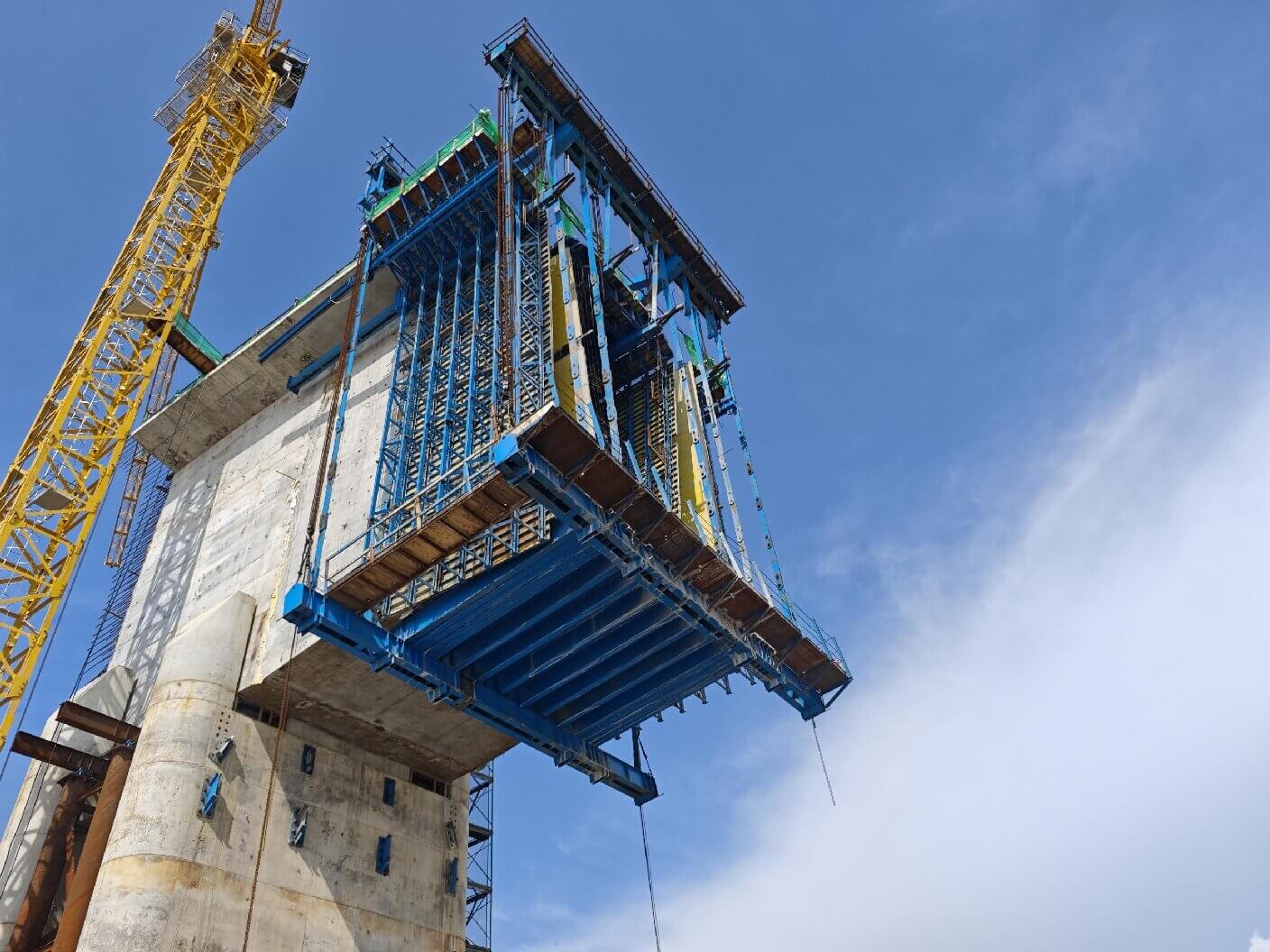
The balanced cantilever carriage is the moving formwork system that travels along the bridge to cast each segment. GETO's carriage uses a diamond-shaped design. The diamond frame has a spacing of 7 metres and an overall frame height of 5.4 metres.
The key to the system is its movement. Front and rear sliding seats allow the truss to run on a track, so the entire assembly advances to the next segment position without being dismantled. The outer mold, the bottom mold, and the inner mold move together with the truss, which keeps the formwork geometry consistent from one segment to the next.
This design matters for two reasons. First, moving the molds as a unit preserves dimensional accuracy, because the formwork is not taken apart and reassembled between segments. Second, it shortens the cycle, because the crew strips, moves, and resets the carriage rather than rebuilding formwork each time.
The carriage is one part of a larger bridge steel formwork system. Around the segmental girder, a project still needs formwork for the piers, bent caps, and foundations, and GETO supplies those as part of the same delivery.
A reference project: Batang Saribas Bridge
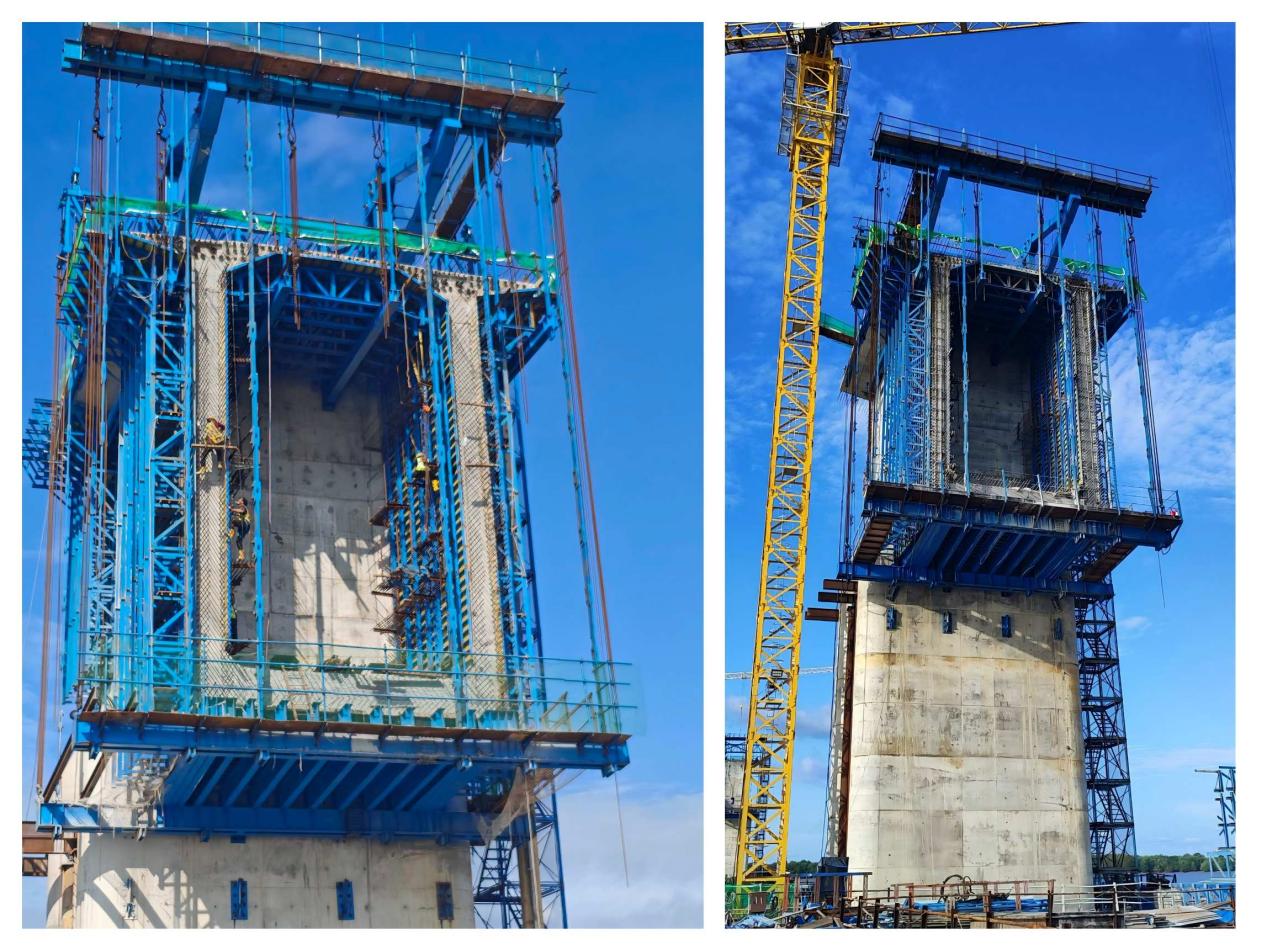
The Batang Saribas Bridge, located in Sarawak, is one of Southeast Asia's longest bridges of its main-span type. The crossing has a total length of about 4,693 metres and a bridge length of 2,390 metres, with a main bridge of 1,110 metres. The structure includes extra-long pile foundations in water, large bearing platforms, high piers, and extra-large spans.
The defining milestone for the balanced cantilever work came with the casting of Segment #1, a 425-ton single-cell prestressed segmental box girder. The project team used balanced cantilever casting with precise load analysis and strict process control to manage the heavy girder in high-altitude cantilever conditions.
Two specific difficulties stood out. The first was asymmetric construction, where the two sides of the cantilever do not advance as perfect mirror images, requiring careful control of load and sequence. The second was aligning the diaphragm at Pier #0's balanced cantilever block, a critical point where the cantilever is anchored. The successful pour of Segment #1 confirmed the reliability of the method and established the reference for the segment work that followed.
Read the Segment #1 balanced cantilever milestone and the full Saribas Bridge case study.
Why precision and load control drive the design
Balanced cantilever formwork succeeds or fails on two things: load analysis and alignment.
Load analysis matters because the cantilever is a temporary structure as well as a permanent one. While a segment is being cast, the carriage, the wet concrete, and the construction loads all act on the advancing cantilever. The formwork has to be designed so those loads are transferred safely back into the already-completed structure.
Alignment matters because each segment sets the reference for the next. A small deviation at an early segment becomes a larger error as the cantilever extends. The carriage's ability to move as a single unit, with the outer, bottom, and inner molds travelling together, helps hold that alignment across many cycles.
For a project team, this means the formwork supplier is not just providing steel. It is providing a system whose geometry, load path, and movement behaviour have to be understood as one integrated design.
When to choose balanced cantilever formwork
Balanced cantilever formwork is not the default for every bridge. It is the right choice when specific conditions apply.
- The span crosses water, a deep valley, or another obstacle where ground-supported falsework is not feasible.
- The bridge uses segmental box girder construction, where segments are cast in sequence.
- The project requires long spans that would make full-span falsework uneconomical.
- The programme needs the formwork to turn over repeatedly, segment after segment, rather than being built once.
When those conditions are present, the balanced cantilever carriage becomes the engine of the superstructure programme. For the surrounding work, the same supplier can provide the piers, bent caps, and foundation formwork, so the segmental work and the substructure work come from one integrated source. See GETO infrastructure solutions for the full range.
Frequently asked questions
What is a balanced cantilever carriage?
It is the moving formwork system that travels along a bridge to cast segmental box girder sections. It uses a truss that runs on a track, with the outer, bottom, and inner molds moving together.
When is balanced cantilever construction used?
It is used for long-span bridges where ground-supported falsework is impractical, such as crossings over deep water, rivers, or steep valleys.
How does GETO's balanced cantilever carriage move?
GETO's carriage uses a diamond-shaped design with front and rear sliding seats that let the truss run on a track, so the molds move to the next segment without being dismantled.
Where has GETO used balanced cantilever formwork?
GETO used it on the Batang Saribas Bridge in Sarawak, casting a 425-ton single-cell prestressed segmental box girder as the key Segment #1.
Plan your long-span bridge with the right formwork
Balanced cantilever formwork turns a long span over water or a valley into a repeatable, controlled sequence. GETO supplies the carriage and the surrounding bridge steel formwork, backed by engineering and on-site support.
Ready to discuss your bridge project? Contact Us to talk with our engineering team, or visit www.getoformwork.com to explore the full product range.