
Ringlock scaffolding is a modular system built for heavy and complex construction. When a project needs temporary access or support that is fast to erect, adaptable to irregular geometry, and strong enough for concrete support or industrial loads, Ringlock is usually on the shortlist.
Buying it well, however, takes more than picking a product page. You need to understand the components, choose the right load series, and check the right things before you order. This article covers those three steps. If you are new to the system, read the Ringlock overview first, then return here for the selection and procurement details.

The components and what each one does
A Ringlock system is a kit of standardized parts. Understanding each part is the first step in procurement, because a complete order depends on getting the mix right.
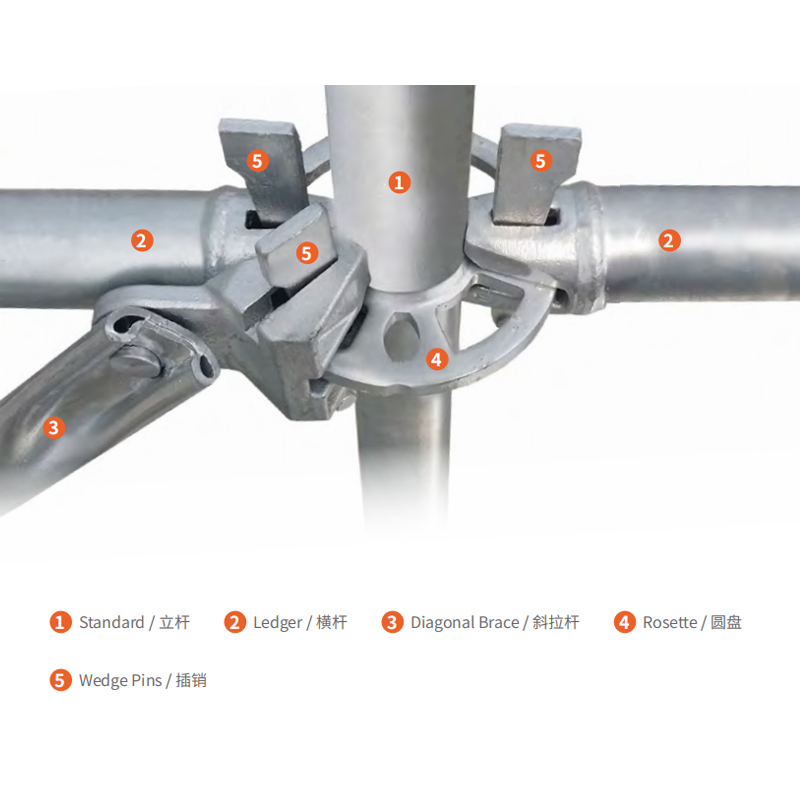
Standards are the vertical members and the primary load path of the scaffold. They transfer loads from the upper levels down to the supporting surface. GETO provides M48 and M60 standard series in Q355 steel, with an outside diameter of 48.3mm and a wall thickness of 3.25mm, in lengths from 500mm to 3000mm. The M60 series is designed for higher load-bearing applications, with a single standard reaching up to 19 tons under specified conditions.
Ledgers are the horizontal members that connect the standards and keep the correct spacing between them. GETO ledgers are generally made from Q235 steel, with an outside diameter of 48.3mm and a wall thickness of 2.75mm, in lengths from 300mm to 2100mm.
Diagonal braces connect standards diagonally to resist lateral movement and improve rigidity. GETO diagonal braces are available in 42mm x 2.75mm sections in a range of length combinations, using Q195 or Q235B material, with re-galvanised or hot-dip galvanised surface treatment.
Jack bases are installed at the bottom of the standards. They transfer the load to the supporting surface and provide height adjustment, which is essential for levelling a scaffold on uneven ground.
Connection accessories complete the system. The rosette is welded to the standard and provides multiple connection positions. The wedge pin locks the ledger or brace head into the rosette. Ledger heads and diagonal heads are the end fittings that engage with the rosette, so the connection works without a separate coupler for every joint.
Load classes: M48 versus M60
The load decision in Ringlock scaffolding is really a series decision. GETO offers two standards, and they are aimed at different kinds of work.
The M48 series is used for lighter civil construction and operating platforms, where the loads are moderate. The M60 series is used for heavier work, such as municipal engineering, cast-in-place beams for rail transit, swivel bridges, and freight viaducts. Under specified conditions, a single M60 standard can carry up to 19 tons.
It is important to treat these as selection guidance, not as a complete capacity statement. The real load capacity of a scaffold depends on component spacing, height, bracing, foundation conditions, wind, and tie-in configuration. Final capacity should come from engineering design, not from a single catalogue figure. For applications that need heavy temporary support, the shoring systems range is the place to compare load-carrying options alongside scaffolding.
A procurement checklist for Ringlock scaffolding
The difference between a good order and an expensive mistake is usually in the details checked before purchase. Use the checklist below when you are comparing suppliers.
1. Material and grade. Confirm the steel grade on the load-bearing parts. GETO uses Q355 steel for the standards and Q235 for the ledgers. Higher-grade steel on the standards is what allows the higher load capacity.
2. Surface treatment. Ask how the components are protected. Hot-dip galvanizing improves corrosion resistance and extends service life, which matters on infrastructure and industrial sites and for equipment that will be reused across projects.
3. Series and load requirements. Choose M48 or M60 based on the actual loads, not on habit. A heavy-duty support application needs the M60 series, while access and light platforms can often be served by M48.
4. Component completeness. Verify that the quotation covers standards, ledgers, diagonal braces, and jack bases, plus the rosettes, wedge pins, ledger heads, and diagonal heads. A quotation that leaves out accessories creates a site problem later.
5. Dimensions and compatibility. Check that the outside diameters, wall thicknesses, and lengths match your drawings, and that the parts are dimensionally compatible with each other.
6. Compliance and documentation. Ask for technical documentation, material specifications, and any applicable standards or local certification. Do not assume compliance; verify it with the manufacturer.
7. Customization and engineering support. Confirm whether the supplier can adjust the configuration to your project and provide engineering support, rather than only selling standard parts.
8. Delivery and after-sales. Confirm how the supplier handles production, shipping, and on-site support. A supplier that provides a full-process service reduces the risk of a late or incomplete delivery.
Frequently asked questions
What is the difference between M48 and M60 Ringlock standards?
The M48 series is for lighter civil work and operating platforms, while the M60 series is for heavier applications such as rail transit beams, swivel bridges, and viaducts. A single M60 standard can reach up to 19 tons under specified conditions.
How much load can a Ringlock scaffold carry?
The load capacity depends on the series, spacing, height, bracing, foundation, and engineering design. The M60 series provides the higher load-bearing option, but final capacity must come from engineering calculation.
What should I check before buying Ringlock scaffolding?
Check the steel grade, surface treatment, series and load requirements, component completeness, dimensions, compliance documentation, customization support, and delivery arrangements.
Can Ringlock scaffolding be customized?
Yes. The modular design allows the configuration to be adjusted to the project's height, load requirements, working environment, and site conditions.
Get the right Ringlock configuration
A complete, correctly specified Ringlock system saves time and avoids the site problems that come from missing parts or the wrong load series. GETO provides the Ringlock scaffolding system with Q355 standards, M48 and M60 series, hot-dip galvanized protection, and engineering support.
Ready to discuss your scaffolding requirements? Contact Us to talk with our engineering team, or visit www.getoformwork.com to explore the full range.